30 September 2014

Digital Games: Week 1

The four rules of the Digital Games MA at Brunel:

1. Do the assigned reading.
2. Get to know the people on your course.
3. Learn the MMF 2.5 software.
4. Play lots and lots of games!

This sums up the first week of games theory and design, a course where booklets are decorated with Scott Pilgrim characters, students have access to all the consoles imaginable and professors quote Star Wars on a regular basis. As a challenge to myself as well as for record keeping, I shall be attempting to record the progress of the course. It has proven to be a very intense program with every day being worth of an entire blog post. To make things easier I will briefly comment on various activities then concentrate on one particular detailed high-light for the week.


Most of this week was spent discovering new games and getting to know classmates. Naturally, we did this over board games which included Once Upon a Time, Castle Panic, Talisman, Jenga, Resistance and a racing board game that had us all in laughing fits at how slow the game was. In the London tube I horrified the english by playing the augmented reality game Face Raiders on a friend's nintendo and learned my lesson on gaming and social conventions. On my own I've played Don't Starve, Prison Architect, Pathogen and Threes with Don't Starve quickly becoming a personal favourite. A lot of these were played on the way to EGX in London where we discovered gems like Mushroom 11, Lumino City and Never Alone. These personal discoveries at EGX are magnificent games that deserve their own blog post but that falls outside the scope of this particular post.

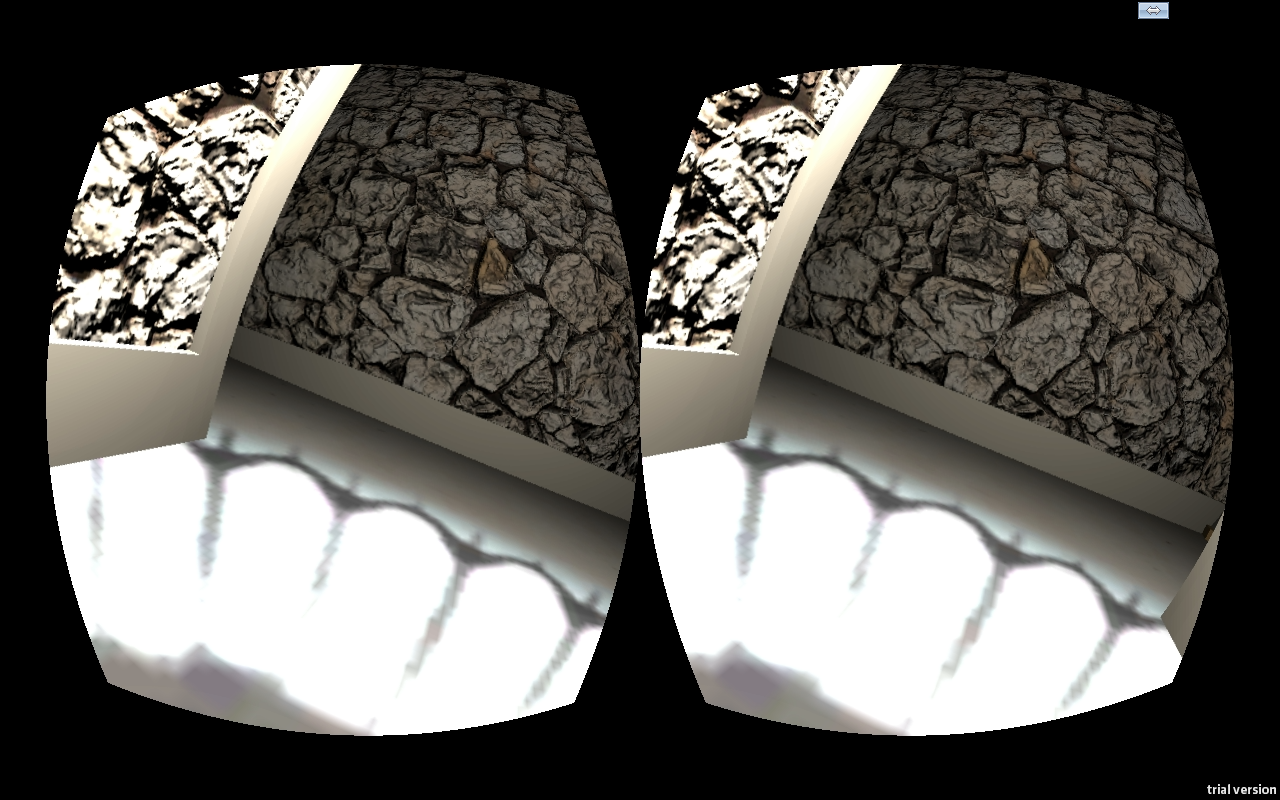
Just an hour into the course and we were already designing and pitching game concepts on the spot. Among a team of four and the key words "burglary" and "fear", we came up with the idea of creating an oculus game all in 5 minutes. You play a mansion owner on a dark, stormy night who's home has been broken into by a burglar. The goal of the game is to get to the phone without either coming across the burglar or loosing all your possessions. While you look at a possession, it is safe from the burglar. Look away though and the next time you look back, it might be gone.


After the class, Tim and I decided to try and make a simplification of the game on MMF 2.5, mainly to learn how to use the program. First I drew a sketch of a top-down, Monaco-styled game which Tim set up to start creating on the software. I decided that the both of us working on creating the same mechanic would be redundant so I began experimenting with various tutorials to get the hang of MMF. One of the first things learned was frame scrolling, followed by having an object follow the mouse. By making that object be a large black image with a transparent centre, I managed to make it look like I was shining a flashlight onto a surface.


At this point is when I realised I had worked out a first-person mechanic for the burglar game. I created a burglar icon that would randomly move across the play area. When it came in contact with your cursor, the game would end. When the burglar was near your mouse, you'd hear footsteps. Then I created a series of "valuables" that would randomly scatter at the beginning of the game. Whenever the burglar came in contact with one, it would disappear and you would loose a point. Finally, I created a telephone that would randomly spawn on the play area. When you find and click on it, you'd ring the police and win.


It took me an afternoon and half the night to make it, most of which was figuring how to do things and the rest refining the behaviour of the burglar and the collision detection to create better gaming experiences. For example, the burglar slows when they are near you so there is more skill involved in avoiding them. Also, I've made the collision area of the cursor smaller so there might be instances of panic where you catch a glimpse of the burglar before they, or you, escape.

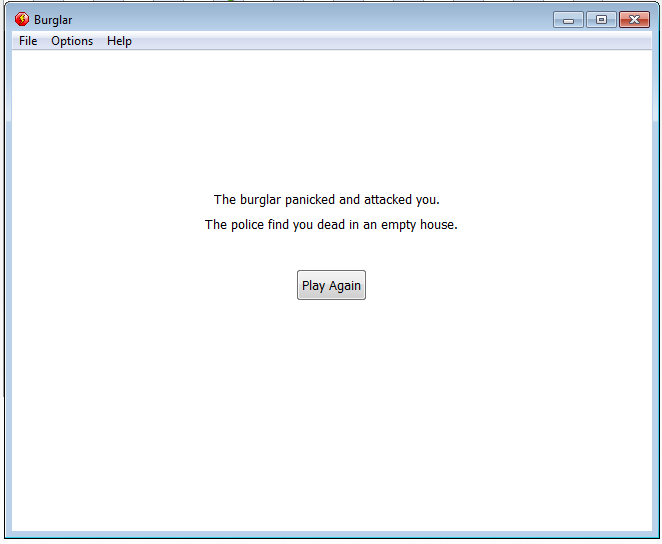
Overall it was quite an entertaining game to create especially as it gave me the opportunity to learn from students in other years during the process, whether it was playing their game demos or asking for technical help. The computer lab at this university houses a very creative community and I can definitely see myself spending most of my time here.

A suggestion that was put forward to me by a generous game player was the thought that controlling a character with the keyboard and the direction of its flashlight with the mouse would make the game more coherent. It would feel less like "shining a light from the cieling onto a floor". I found myself agreeing with him as this also means that I could play with the speed of the character and therefore the feel of the context. Perhaps this should be a project for next week.

13 March 2014

On Writing a Personal Statement

Recently my inbox has been filled with friends panicking about their personal statements. While I enjoy proofreading, I thought maybe publishing my own writing process might be of some use to somebody. The application was for a masters course in Brunel University but the steps can be applied for other degrees. I got an offer three weeks after my application so I must have been doing something right.

Step 1 Jot down all the things you've done these past few years that are important to you along with what you learned from them. Don't worry about whether or not it fits the course at this point. This should be a mix of accomplishments you're proud of and would eagerly show off given the chance. I wrote mine in a spider diagram to see how all of the activities linked together.


Step 2 Write down the course requirements and aims found on the university website and highlight any key words. Try to analyse exactly what it is they are looking for. On mine for example I identified four main categories: research skills, analytical skills, innovation and future plans.


Step 3 Go back to your diagram from step 1 and identify how your recent activity satisfies their course requirements. On mine I gave a colour to each of the categories (research, analytical, innovation, future) and put a dot of that colour to the things I've done that prove these skills. This is also a good way to see if the course is actually right for you. If it is, the requirements will fit your past experience like a glove.

Step 4 Organise your web diagram into bullet points using the words highlighted from step 2. This is the bare bones of your personal statement, just the core concepts you want to message across. Colour code these as well as it will help you identify which bullet points are important and which are superfluous.


Step 5 Research the staff that are going to be teaching you. What do they have to say on the course? What is their area of expertise? Write down any books or papers they have written and read them! If this is the right course you will surely find quite a few that are interesting to you.


Step 6 Start writing your statement. Don't think about how it sounds just yet, just link together the bullet points from step 4 into something coherent. Once you're done with that go back and start editing. Put yourself in the shoes of the university. If you've done step 5, this shouldn't be too hard. Keep referring back to the course requirements if you get stuck.

Step 7 Show your statement to people. The more the better though it helps a lot if you have someone who is experienced either in proofreading or the industry. For example for my application into a games course, I asked my contacts in the games industry to read it. Keep an open mind and remember to weigh other peoples edits against your own core concepts.

Step 8 Put the statement away. Go do a roadtrip, play videogames non-stop for an entire weekend, hang out at the pub, whatever you do to distract yourself from the daunting thought that is your uncertain future. Once you've had enough beers, beaten enough bosses or gotten tired of travelling, open up your statement again and read it. Do whatever changes you feel you have to do until you are happy with how it sounds and show it again to your contacts.

Step 9 Read your statement again. Does it go above and beyond answering your universities questions? Does it make you sound like you can take on their course? Does it make you feel proud and accomplished? Do your proofreaders agree? Then congratulations, you are ready to send off your personal statement.

Hope I was of some help and good luck!

12 March 2014

Misc Doodles and Wisdom of Architecture School

I recently received the news that I got into Brunel University to study my masters in Digital Games: Theory and Design. Surely, it is no wonder I am beyond excited to begin!

Thinking about going back to university I remembered all those moleskins I filled during my architecture course at the Canterbury School of Architecture, UCA. Aside from all the building sketches and perspective lines, movement studies and plans, I'd often sketch things that were not exactly architecture, but were not exactly anything else either. Simply knowledge and experiences collected during the three years in Canterbury. Here are a few.

But the truly dearest is the back page of the moleskin, where a few friends decided it would be great to leave their own signatures.


Perhaps its wishful thinking but I like to think I'm not exactly leaving architecture. Having done three years of it, it has heavily shaped the way I approach game design and I will continue to sketch, analyse and create from the architecture around me.

4 November 2013

Adventuring through Morocco

“The world is a book and those who do not travel read only one page.”  - Augustine of Hippo

When I was a pre-teen my parents would talk about how privileged my sister and I were for living in so many European countries. My parents didn't leave Spain until they were 18. I complained that I would turn 18 and I would have never left Europe. I am 21 now and tomorrow I will be flying to Marrakech, Morocco, Africa.


If you would like to follow my travels, you can do so here: travelthestory.blogspot.com

18 October 2013

Passages at the Ateneo of Madrid

Sculptures by Ulla Haga. Paintings by Erica Fromme
Photographed by me.


Calderón de la Barca and Velázquez believed that artists were intellectuals to be treated with respect. After three days of socialising with magnificently inspirational artist in Madrid, I cannot see how anyone could think any other way.

I originally went to the capital as moral support for my mother, Rosa Mascarell-Dauder, who co-curated with Trevisan International an exhibition at the heart of Madrid. Artists from all over the world had sent boxes of paintings and sculptures to her and my father's apartment to the point where navigating the living-room was a task for Theseus and Ariadne. A few transports to the exhibition hall later and I was soon talked into being the event's photographer and hired as a translator for next day's tour of Madrid.

Rosa (Mother), Rosario, Paola and Borja (Father) unpacking artwork at the venue.

After days of unpacking and whitewashing and fixing lights, everything culminated with a congregation of great thinkers at the exhibition opening. Essays could be written on how inspirational not just the minds behind the artworks were but the people standing behind the artists too. I will not attempt to condense the genious and say, if you are in Madrid, swing by the Ateneo and contemplate their magnificent artwork.

The artists.

As for the tour of Madrid, did you know the Calle del León is called that way because a man used to keep a lion on that street as an exotic pet and let people see it for some coins?

16 October 2013

___ in [ ___ ] Development

You can replace the  ___  in [ ___ ] Development with nearly anything. Space, game, historial, scientific, personal...

I wrote the title for this blog in the middle of my architecture course at a time of doubt. It was around when I was creating the UCA Engineers club because I missed sitting in my further maths class solving away at mechanics problems or when I picked up a bit of programming because of the fascinating things you can do with computers and robotics or philosophising with Samuel Lowe because of everything new I learned when we did.

Only one thing has been very clear to me since the beginning: I want to push things forward. So think of this as a bit of a disclaimer for this blog. I am not a master, simply an overly eager mind making sense of the information and problems that she stumbles upon.

23 August 2013

New Studio and Rosetation

 
Galaxy Rise Games now has a studio!  Beginning of this month Adrian May and I moved to Gandía, Spain to fully dedicate our time to the Oculus Rift. A few paellas and beach days later our equipment arrived and we are set and ready to work.


Before working on our main game, Adrian and I have created Rosetation, now in its testing phase. In July I mentioned a little something I wanted to try out for the Oculus Rift based on observations of Proton Pulse and other sensations of height and speed. This game has evolved and we are now making it for the VR Jam.

Rosetation being my first start to finish game, there were many times where I felt like I had been dropped in a maze of freezing cold water and left to figure things out. With perseverance and guidance from Adrian things worked out and honestly, it feels amazing. A lot of lessons have been learned and the prospect of how much more I still have to explore is truly exciting!

I spent the majority of these three weeks:
+ Writing up and explaining the game, its mechanics, levels and concepts to Adrian.
+ Modelling and texturing the assets in Maya.
+ Discovering displacement mapping, how awesome it looks and how Unity doesn't support it.
+ Setting up assets in Unity ready to be programmed.
+ Fidddling with the scene's lighting to get the right environment. 
+ Discussing technical problems with Adrian and researching solutions.
+ Reading and editing code to improve gameplay based on observation and feedback.

Though the VR Jam is ending soon, I will be playing with this game a bit more and keep on testing.