3 June 2015

Dissertation: Month of May

Six hours a day, five days a week from now until September is the rough schedule for dissertation work. While most of it has been spent making the most of opportunities outside the course, it's time to focus on what I came here to do. It's dissertation time.


Days have been spent writing on windows, drawing clouds of thoughts that would combine into storms of ideas. I've been trying to find a string that would tie together the research I've been doing over the course of this academic year. This includes fields such as architecture, geography and games design, writers from Henri Lefebvre to Henry Jenkins, games like Gone Home or Year Walk, environmental storytelling, immersion, navigation, urban narratives and of course my sweetheart: psychogeography.

A little snippet of what I plan to do:
Walking is a practice that has gone beyond the mechanics of bodily movement. It is endowed in meaning, critical and aesthetic, environmental and personal. In 1790, Wordsworth and Jones began a 2000 mile journey through the European continent.  The hypnotic rhythm of walking stunned them with fatigue and raised them to a plane of transcendence (Self, 2015). Walking to the early British psychogeographers was a route to spirituality in a disenchanted world. The nineteenth century flaneur, a leisurely observer of urban space, would end up immersing themselves into the intoxicating past of the city (Benjamin, 1939) similar to the ‘deambulation’ practices of Surrealists who would walk to reach a state of hypnosis (Basset, 2007). This immersion into the landscape allowed for the excavations of hidden secrets and exploration of spatial patterns. The exploration of landscapes was used politically by the Situationists International (Sadler, 1999) and as a window into an occult mysticism of the city by British psychogeographers (Coverley, 2010).
Like the Situationists International, geographers like Michel de Certeau (1988) use the immersion invoked in walking to read cities. Walking is a spatial trajectory that allows the exploration of hidden stories, embedded in the landscape. Early writings followed the spatial pursuit of a secret. In Edgar Allan Poe’s Man of the Crowd (1840), the writer followed the nightly wanderings of a man through London. Throughout the voyage, in which the author falls deeper into the hypnosis of insomnia and the rhythms of the walk, Poe takes a psychological anonyme. He abandons his identity so he can reattach himself to that of the vagabonding stranger and at the same time assume the position of Walter Benjamin’s archaeologist, collector and flaneur. In his alienated position, the flaneur can excavate the hidden secrets of nighttime London.
At the heart of the ‘derive’, or ‘drift’, is a ‘playful-constructive behaviour’ (Debord, 1958). Playful walking represented a fight against the boredom of the modernist city and the delusions of control (Chtcheglov, 1953). It aims to excite the body and the senses through the sudden changes in ambiance in an attitude of resistance against functionality. The practice is often considered an ‘elaborate game’ by geographers (Bassett, 2007: p.401). One that draws a player's attention to the stories of the environment.
The steam store has seen a sudden appropriation of the term “walking simulator” used on games such as Year Walk (Simogo, 2013), Gone Home (Fullbright, 2013), Dear Esther (The Chinese Room, 2012), The Vanishing of Ethan Carter (The Astronauts, 2014), The Stanley Parable (Galactic Cafe, 2011) and Life is Strange (Dontnod, 2015). Even games from before the term was coined such as Myst (Cyan, 1993) have been tagged as a walking simulator. This project is a literary analysis into the patterns of these games, arguing that at the core of their design is the psychogeographic derive.
This project will concentrate on Year Walk and Gone Home as two examples of walking simulators. Year Walk has been chosen for its critical acclaim (Unity, 2013; BAFTA, 2014) as well as its strong references to psychogeographic practices. Gone Home has been chosen for the writers extended experience with the game as well as its use as a point of reference for other walking simulators. It will identify the similarities between walking simulators and derives by comparing these two games, formally and aesthetically, to psychogeographic practices. Through the use of a gameplay log, it will identify the games goals and mechanics as well as their use of environmental storytelling and ludic experience.It thus argues that an understanding of psychogeography, its practice and reading, can help create more immersive environmental storytelling games such as walking simulators.

I'm aiming to have the essay come in conjunction with a game demo. What the game is going to be is still a bit up in the clouds. To brainstorm I've been walking down the route of Valencian rondalles, les falles and various other local traditions. I think it's time I put my home city on my map of games.


22 May 2015

London Spring and Games

Spring in London is the season of picnics, rooftop networking and plenty of opportunities. Us Brunelians have dived straight into it.


A team of masters students have started a game design collective by the name of Untold Rubies. We design games for studios, filmmakers and competitions. Really good news and interesting doors have opened up since we started laying down the groundwork in winter. Working with game and film studios, we have made many prototypes, game design documents and artwork. My role was mainly in game design, layouting and editing of documents, and art asset creation. Two projects have been particularly successful.

On the 30th of April a team of us submitted E-Sol, an entertaining and informing mobile game that interacts with pollution databases across Europe, to the MYGEOSS European Commission competition. We won! With the EU grant under our belts, we are now in the works of making this game a reality. But first a bit about the game and how it came to be.


E-Sol gives players a virtual pet plant named Sunny who needs your protection from air pollution. The more attention you give your plant, the happier it will become and the faster it will grow. However Sunny is directly affected by the air pollution of the country it is in needing you to clean the air, water it and encouraging it to stay happy and grow tall. The game promotes environmental awareness to young children and encourages them to learn about air pollution levels across their country as well as the rest of Europe.

The project started when I received a very enthusiastic call from Andreas Paspatis about an opportunity for Untold Rubies. A group of us gathered and began brainstorming for an interesting way of beautifully showing the data provided by MYGEOSS. The challenge: we had a week to bring it all together. Luckily, we have a lot of talent in our collective. Many daily meetings, sleepless nights on Photoshop and discussions over tea and whiteboards were had. A day before the deadline I was arranging Pong Nantapan and mine's artwork on InDesign. Then playing with fonts for the excellent text Andreas, Toni Brasting, Tim Philips, Givoanni Rubino and Daniel Thompson had written. A week of insane work payed off with such talented people on the team. Our game was picked as the top 10 apps and won the European Commission grant.

The winning GDD will be made public on the 10th of November.


Shortly after the E-Sol project, we were contacted by Kate Stonehill, documentary filmmaker applying for the Tribeca New Media Fund. The brief was to create a game to complement her documentary on a very interesting development on the West Bank. "A Palestinian millionaire has built the fist futuristic, high-tech city in Palestine but the fate of his dream city is threatened when an Israeli official refuses to supply the city with water." I jumped at the opportunity to work on such a game. In collaboration we created DRIP, a game where players assume the role of water and navigate the pipe infrastructure of the West Bank. On their journey, they become witnesses to a multitude of events and discussions relating to the conflicts in the West Bank.

The proposal has been submitted to the Tribeca New Media Fund and we are looking at beginning the development of DRIP in late 2015. You can view the game design document here.

With so many projects popping up, I think it is time I temporarily retire from these rooftop networkings, however fun they may be.

12 May 2015

Digital Games: The Final Taught Weeks

The last taught classes of the masters course are done and the final assessments have been handed in. But the young game designer never rests. The past two months have been a series of non-stop work straight through the Easter holidays and into the summer break. It included pitching, theory work and creating a game demo.

Geopets was the focus in design. A solo project for the game design module. Geopets is an augmented reality iPhone/iPad tamagochi that uses geolocation and object recognition software to pin your pets to a particular location in the city. Originally, it began with the idea of using magic realism to enchant the day to day lives of citizens. Some brainstorming later and it had evolved to enchanting Londoner's commutes with creatures hidden in the city.


The pitch was done entirely using Adobe After Effects. The result was a 10 minute long animated presentation that illustrated the game. It took a relentless fueled week to create the presentation, including artwork and practicing the timing. Above is a short compilation of some of the highlights of the presentation.

After pitching the game comes making it. There were massive limitations in terms of tech (augmented reality and geolocation services in particular), however I found ways to simulate the feel of it through the games presentation. As this project was entirely solo, the biggest problems were overcome through feedback. A week into creating the demo I had people playing prototypes of the games. It became invaluable to making the game flow smoothly in ways that players could understand intuitively


Above are various screenshots of the demo. You can play the game here.

Theory work centered on my ongoing research on psychogeography in virtual worlds. This particular one featured how the architecture of Skyrim evoked a sense of place, drawing together fields of geography, myth and virtuality. Will Self's lectures were particularly useful in broadening the scope of the paper beyond games design.

End of March we had a Brunel research evening in which a group of us lecturers and students presented our research. You can read all about it in Ashley's blog.

And with that, the taught section of the course is over. Bring along the dissertation!

13 March 2015

Made in Brunel

Our game, Meeting, is now an award-winning game! Judged and awarded by Steve Jackson, co-founder of the Games Workshop, Lionhead Studios and writer of the Fighting Fantasty series. Here we are, accepting the award at the Made in Brunel event. From left to right: Steve Jackson, Matthew Halls, Tim Phillips, Rosa Carbo-Mascarell, Dan Thompson and Olga Guseva.


How it happened: Every year the Department of Computer Science hosts a software innovation event where students showcase their software to academics and professionals. This was the first year (of hopefully many years) that Games Design collaborated in the event. The heads of Game Design decided which would be the four chosen games to be displayed at the event. Apparently it took some "heated debate with some wrestling and walking over fire challenges" before deciding on the games. The four games that were finally chosen were "What do we do now?", "Tribe", "Nope!" and "Meeting".

The event itself was a very busy success. There was a blurr of many game players and curious students. Dan did an amazing job at describing our game to newcomers and many players high-fived each other when completing the game.


The highlight of our showcasing was when Steve Jackson came around to play our game. There was much laughter and banter ping-ponging between Steve Jackson and his co-op as they played Meeting. After plenty of shouting across laptops, they solved the puzzle with much cheering, back-patting and hand-shakes. As a game designer, seeing the two players leave the game buzzing with camaraderie and amusement was the most rewarding experience of the event.


The games showcased at the Made in Brunel were all made as part of the Global Game Jam 2015 in collaboration with the department of computer science. If you are interested in the event, I have written about the experience here. I am incredibly proud of the games my fellow Brunel students have made. If you have a chance, make sure to check them out at the GGJ website here.

Read about the award-winning Meeting on Gamasutra.

Play v1 of the game!

4 March 2015

Digital Games: Weeks 22-23

Story was the requirement for the weekly game. We discussed branching narratives and how to make a story appear non-linear. As an example, we looked at Harry Potter. How different would the story experience be if the exact same things happened but Harry was portrayed as an evil antagonist?

I paired up with Toni (who's storytelling skills have awed the course more than once) and made a game inspired by a short film. "Feeders" is an anti-commercial about psychic vampires - beings that suck your energy dry.


The game is set around a dinner party with old friends and rising tensions. The way you respond to conversation changes people's mood around the table. Toni did an amazing job at the script which Ivo, director and creator of Feeders, Toni and I then edited together.


We used various game design tricks to give the sensation of non-linearity. Starting with the player feedback loops: upon making a choice in dialogue, the facial expressions of the characters change, giving the player a sensation of meaningful choice. The script itself follows the same topics and happenings, the only difference is the tone in which the characters can respond. They have three moods: positive, neutral and negative. Because of these changing tones and moods, players can get a different perception of the characters. For example in one playthrough, Lorenzo might be really aggressive, in another he might be really loving. This can tint the player's opinion of who is the psychic vampire.

You can play the game here.


In theory we discussed race the first week and age the second and both were preceded with a fun exercise related to each topic. For race we had to create a fantasy or sci-fi race that was not based on any real-life cultural references. The stuff some people came up with was hilarious but probably the most profound lesson learned from the exercise was this: If play is the basis of all culture, then the first question we should ask ourselves when designing a culture is "how do they play?"

The second exercise was a look at representation of age in games. I went on a quest on Reddit to look for women over 40 to see if I could identify any patterns or, in fact, if any existed. Many answers were given and I collated portraits of the highest voted replies. Luckily, I was pleasantly surprised at the range and complexity of female characters over 40. Less so when I looked at how many of these women were playable characters.


For the second week I took a break from the a game a week exercise due to other commitments. While at a loss in terms of game design practice, it has allowed me to step back and evaluate my schedule. Deadlines are looming. It's time to fight these hand-ins with my deadly post-it notes of ultimate planning.

21 February 2015

Digital Games: Weeks 20-21

I'm not quite sure how to begin about these two weeks as it was a roller-coaster of events that ended with Tim and me working night and day to make a game about sex and contraception.

Before I continue, let me do a little disclaimer: If you are uncomfortable with sex, female sexuality, contraception and personal women's issues you might want to skip this blog entry. I've thought long and hard about how to go about this professionally but there is no way to talk about the very personal game Tim and I made this week without raising well... personal female issues. If you are uncomfortable with this in any way, I suggest you stop reading here.


It started with a strand of contraceptive pills that unleashed its wrath complete with sudden depression, debilitating migraines and violent mood alterations. Around me, we were discussing some very heart-felt topics in Ashley's theory class. The first was gamer culture and gatekeeping issues women face, the second was gender representation and sex in videogames. The first left me in a pit of hopelessness, the second with the powerful outlook that I could change something. So when Justin gave us the task to create a game with strong use of numbers and balancing systems, I knew what I had to do.

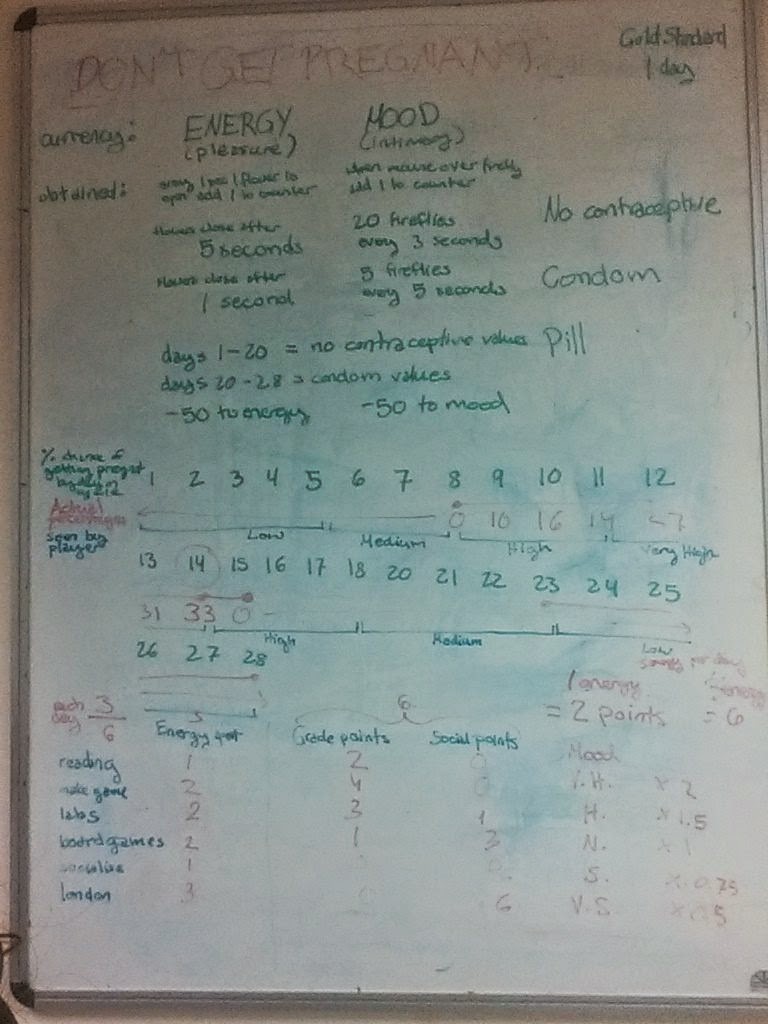
The goal was this: Create a game that would voice a problem a lot of young women have to face. Namely, (if they wish to) not getting pregnant. You play a young woman who is starting university with the aim to get amazing grades and great friends. Her boyfriend moved with her and the last thing she needs on her plate is a pregnancy. The game is one of balancing fertility, contraception and its effects with day to day life.

I went to Tim for game design advice and he exploded with great ideas and enthusiasm. He came onboard and we sailed off to create a sex-positive exploration of female sexuality and contraceptive use. Of course, true to the design task that Justin set us to do, it was backed by a mathematical system of balancing numbers: intimacy, pleasure and day to day activities.


The news spread quickly in the university labs that Tim and I were making "a sex game". We were approached many times by bewildered and curious faces. Often both at the same time. As we came closer to Wednesday, I worried about presenting the game to a male-heavy class however the reactions of some ("What is the pill?" "You have to take it every day?! That's so tedious!" "What does this day in cycle mean?") made it all the stronger. By putting players in the shoes of a sexually active female character, those that were uninformed became curious, asked questions, they initiated conversations on female issues as in the context of this game it also became the player's issues.


At this point I need to mention the game is far from perfect right now (like the very humorous but inappropriate need to have sex every night in the game to move onto the next day) but as a prototype of a more polished life-style game, it really works to spark curiosity, play with systems and, most importantly, empathise.

You can download and play the game here.

3 February 2015

Digital Games: Week 19

So many developments on the psychogeographic end have happened this week starting with auditing Will Self's classes. Various students in game design heard about my work on psychogeography in virtual worlds and let me know that the quirky and legendary Will Self is a professor at Brunel. After contacting him, he was kind enough to let me audit his weekly module literally called "Psychogeography" where he trains and takes students on derives. The experience was fantastic! The most fun I've had in a while. I'm so looking forward to Monday mornings.

On the other hand, in Design class, Justin introduced us to the topic of the week: out of the box. We are to create a game without thinking what a game should be. As an example he showed us three videos:


There were many great points made that have stuck with me. 1. Don't give a damn about rules. 2. When you forget the rules and play with your medium, you will fail 99% of the time. But 1% will be amazingly innovative and eventually become mainstream in the medium. 3. There are no rules to being creative. In fact creativity is often so out there that it is dangerous and, quite honestly, scary.

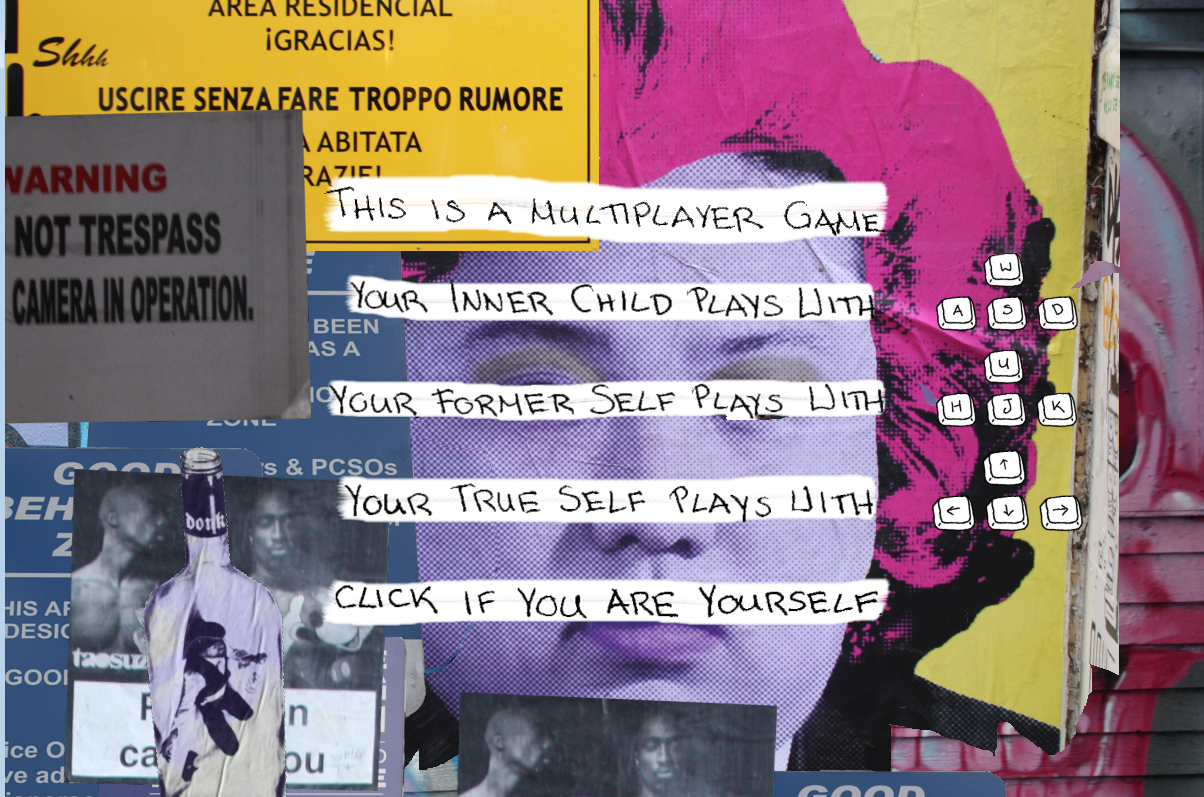
I paired off with Tim for this exercise and suggested an idea: "Let's make the first psychogeographic videogame." There have been movies, there have been drawings, there have been texts. But what would it look like as a digital game? Honestly, one week is not enough to explore this concept but we gave it a full day where we grabbed the metropolitan line all the way to the end, wandered, and then tried to express our observations through gameplay.


So what did we observe? Contradictions. Plenty of ridiculous contradictions. Government signs prohibiting drinking in the streets while two meters away, a barista practiced his juggling skills with a plastic alcohol bottle and cocktail cup. We saw a car park with a big "No Parking" sign. A coffee shop that called itself the Antishop. While Shoreditch puts on a facade of quirky liberation, it is still surrounded by corporate glass high-rises and considered a "good behaviour zone" in the controlling fist of the police.


What game came out of this? One precisely about these contradictions. Tim and I spent two days playing around in MMF and in between we watched Salvador Dali and Luis Bunyuel's L'Age D'Or. We observed that the film is full with meaning, only that they would put the message above anything else, including reality. For example, there is a close up shot of a character who has flies all over his face because he is literally "a piece of crap".


We collaged images from our trip and gave them behaviours to literally represent our observations from our psychogeographic wander. I will not say anymore since I feel this is very much a game that is a game for a reason: it cannot be expressed in anything that is not a game. (Although whether or not this is a game can be really contested. But that was the least of our worries.) You can play the game here.