8 October 2015

Dissertation: Month of September


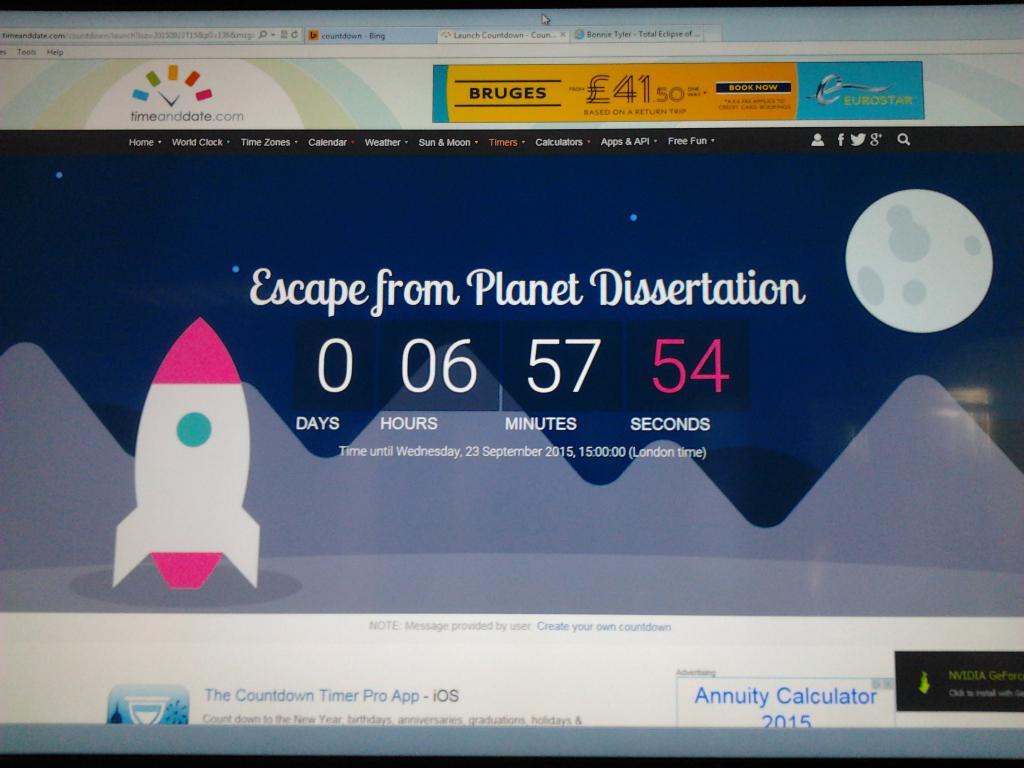
Most of the month started with one big content rush to complete the pre-alpha stage of my game in time for playtesting day and the rest was spent implementing feedback and getting supportive friends and family to review my written submission. In that time I managed to polish my writing, to make sure my points came across clearly and thoughts flowed smoothly. Also I made some major changes to the UI and fixed bugs in the game. More of that can be read about on the playtesting day blog entry. On the 23rd, I successfully submitted my masters dissertation.

Overall I feel very proud of what I've managed to achieve in 4 months. I think the power of environmental storytelling and games as an expression of an artist's subjective state is an area that is only just flourishing in the games industry. Being able to dedicate an entire semester to psychogeography in games has been very enriching and I've had so much fun immersing myself in the spirit of the Romantics.


There were also challenges in spending four months on independent research and development. When working on a solo project, self management became such an important task in assuring the health of the project and myself. It was thanks to all the Gantt charts and sticky notes that I didn't have to take an all nighter at any point. A vast improvement from the weekly all nighters when undertaking my architecture undergraduate. The input of others also became invaluable to the short-sightedness that often occurs when working alone. That includes not just the kind friends and family who took the time to read and/or playtest my dissertation, but also those that asked me in passing what my project was about. Being able to describe it in a sentence or two really helped me put the project in focus and perspective.


Should my dissertation be deemed worthy by my professors, I plan on taking my work onto more public platforms. With so much great feedback, including this very well written and humbling review by Jack Lowe, I'm hoping to optimize my game for tablets by the end of the year. I'd love to be able to go to events and gatherings and pop out the game for others to play. As it is such a short piece (now that the key issue has been fixed) it would work quite well as a self contained experience.


All in all, it has been a very rich year and I am incredibly melancholic it is over. This course had not only helped me gain confidence in my game design skills but has also been the seed of lasting relationships and budding opportunities. We are a cool class and I have no doubt we are all going to do some amazing things. As for my own path, I have moved down to Brighton where I will be starting my volunteership at 4 times BAFTA nominated and all round geniuses, Blast Theory. In the meantime, look out for blog posts on cool indie games events and artist's happenings in London and Brighton. 

And bring on the next stage!

12 September 2015

Dissertation: Playtesting Day

On the 10th of September our professors kindly let us invite non-Brunel students onto campus to try our games. With that extra pressure of completing something presentable for outside eyes, us masters bonded over tight deadlines and development sprints. Hours before the doors opened we were pinched over last minute bug fixes, keyboards clacking as we polished gameplay.


The event was busy, guests traveled from as far as Canterbury and Cambridge to play our games. (Thank you!) We were overwhelmed by the interest and we welcomed everyone with drinks, cookies and controllers. With only three hours in which to play games and so many playtesters, not everyone got to play all the games. However everyone seemed satisfied with what they got out of the day and we ended the event with some celebratory drinks at the pub.

Thank you Ashley for the picture!
My notebook is filled with notes. Some of the biggest observations was my gross underestimation of the time it would take to play the game. While originally I was expecting it to take 10 or so minutes, the reality of it was closer to 40 minutes. It was a similar mistake to the one we did during Meeting. A puzzle that would take 1 minute to complete for us designers would take 20 for two completely new players. In this game, the time difference was greatly to do with the amount of content in the game (people spent an average of half a minute looking at things, then rechecking them for the number code for the safe). However what took the most time was the fact that the key was accidentally really well hidden. While it took up a quarter of the screen, everyone seemed to overlook it to the point that I would have to interfere in every game session at around the 30 minute mark. It was an interesting optical illusion and while funny to a lot of players, it will have to change.

Some things that worried me before playtesting day were settled. My game has a strange navigation system that might be more intuitive for tablets but on PC might seem a bit esoteric. However the instructions were clear to almost all players and after two minutes they could control the device with ease. To be absolutely sure, I might add an extra line of text to go with the current animations.

While I like everything being diegetic, it will also be easier to include a system that makes it clearer what objects can and can't be interacted with as some players would resort to clicking on everything. This might not need to be the case in the tablet version but for PC, the platform on which it is being graded, it will make interactions smoother. Also, I will have to add in the option to read handwriting as typed text as some players had difficulties with a few words.


The overall feedback was fantastic! After finishing the game I would ask my playtesters: "What do you think happened?" What a relief it was to hear them relate back to me what I was trying to say! Everyone understood my main point while reacting differently to it, the more observant players would go deeper into the story, others caught the references to surrealists and romantics. One of the playtesters, Adam, put it wonderfully: There are many layers to the story. Not everyone will explore the deepest layer but everyone got the overarching concept.

I'd like to thank everyone who took the time to play my game:

Negin Aminy Raouf
Charles Weston-Smith
Adam Chladek
Jack Lowe
Joseph Moran
Ivo Chladek

Your feedback is helping me greatly in polishing up this game. And apologies to those that wished to play but where cut short by the time. Drop me an e-mail and I'll be happy to send you the prototype.

With so much to do, us masters are living 24/7 in the labs while we all finish up our games. Wish us luck!

4 September 2015

Dissertation: Month of August

The quick rundown: The paper has been sent to various of my very kind friends and family for proofreading. Thank you everyone who gave me feedback! I owe you a beverage for taking the time to read a very lengthy essay and put in the brainpower to criticise an academic text. After standing so close to my writing, getting fresh eyes has been very encouraging. I can safely say the paper is a couple of days off from being ready.


Most of the month of August has been spent creating the ludic sketch. No matter how short I've tried to make it, a game takes its time and getting it all done in 6 weeks is proving a challenge. The most time consuming factor has been the content but, as it is a game based on environmental exploration, content is everything. I'm not very happy with the art but with how little time I have it is going to have to wait. But all is going well and I should be going into testing next week. Which brings me to...

On the 10th of September we are holding a playtesting day at Brunel University London. This is all thanks to our very kind tutors who let us open the labs to guests. Setting myself such a harsh deadline has been tough but productive. The game definitely needs to be of a good enough quality by then.


And with that, I'm delving right back to work.

2 August 2015

Dissertation: Month of July

Brunel students, there is a wonderful patch of tall grass between Isambard and Cowley Road in which to get lost. If you keep exploring you might find perfect picnic alcoves and secret gathering spots. Keep walking and you might come across a 20-something talking animatedly into her phone, except no one is on the other line. That would be me, and just this month I was wondering why a town, street or house would lay completely abandoned and what the core message of my game would be.

The story and the mechanics of the game are there, both birthed out of each other and capture the requirements I outlined the month before. Even some of the ideas that arose from that one afternoon on a Barcelona balcony made it's way into the game. I spent some time placing the story in various settings and observing how it changed however I ended up going with what made the most thematic connections, with a setting that represented from all perspectives what I will be trying to say.


I'm thinking these two images, by the same Caspar David Friedrich, when placed next to each other. And Sylvia Plath's "Yes, God, I want to talk to everybody I can as deeply as I can, I want to be able to sleep in an open field, to travel west, to walk freely at night." I'm thinking Anna Karenina, her mind consuming itself indoors. Le Corbusier calling homes "machines for living" and Will Self's spiritual exultations in the classroom and on walks. Yes, I am being vague on purpose because nothing will show it better than the game (if all goes well).

After the walk, I set off to test the core mechanics. Nine lines of code later and I had a rhythmic walk that made use of parallax and the technicalities of a tablet. Some digital brushstrokes later I had a sky (shown below) and some mountains which move to the rhythm of the tablet. Watching it come together in one satisfying afternoon is getting me all excited to get this game done and out there.


But there is still a lot to plan until then. Like for example the placement of the story in the environment. Something I have been working on through the help of post it notes and markers, and of course by making friends play it through like a text-based adventure game. The shape of the house has changed so much while placing the story in it. Everything from the objects to the style of the architecture is becoming a metaphor for the characters and the mechanics.


Over the course of the next week I will be working on re-drafting the first version of the essay. Maybe it's because I've been in the same room for so long while writing, it's been a really slow process. I'll be printing out the essay and writing by hand this week in hopes it might help loosen up that creativity. Onwards!

16 July 2015

Develop Brighton and the Role of Games Education

The late 1950's film industry saw a revolution in their medium through names like Federico Fellini and Ingmar Bergman. The primary distinction from their anterior maestros is that these filmmakers had studied their crafts at universities. They understood their semiotics and aesthetics and this strengthened their script concepts and filmic frame. It lead to innovation. It is my belief that we have reached a similar point in the games industry.


This Wednesday, Tim Phillips and I tubed and trained our way from Brunel University to Brighton. It wouldn't be my first time at Develop: Brighton, a game developer conference where indies dress up like their triangle-breasted characters, academics mentor visiting students, and Peter Molyneux makes ghostly strolls on his phone. Though slightly sleep deprived from days of working on our dissertations, we jumped from stand to stand, playing games and debating the state of the industry with developers and fans.

We must have played every game at the expo when Tim collapsed on a bean bag. I had just been talking animatedly with the masters students at the National Film and Television School and my mind was sparking with excitement, frustrations and ideas. In that pause Tim and I shared a thought:

The most innovative game designs are coming out of universities. The boundaries of games were pushed that day by people like Mata and Elwin of SassyBot, Paul Dillon of Cupboard Games and the various students of the National Film and Television School. They have games that break our understanding of agency, transform storytelling or go Dali and take you on an experience on the development of an egg.

We are at the game industry's European New Wave where the Henry Jenkin's and the Janet Murray's guide the university student's design decisions and expressive journeys. Through a deep understanding of theory, these developers strengthen their craft. It is no wonder to me that they are coming out of universities.

Underneath the burnt shadow of the long-gone Brighton Pier, I watched in wonder as Tim Phillips transformed a traditional hack-and-slash mechanic into a piece-together-narrative, Quantum Leap game in the style of Hitchcock's Rear Window. It is minds like these, minds that understand the theory, who will have the basis with which to break the factory mould of the games industry. University students are going to change games.

11 July 2015

Midnight Scanning


Three hours ago master visualiser Atahan circled a Kinect around me as I watched a 3D replica of myself form on screen. He opened me up in blender and turned me into quicksilver and silk, marble and glass. Below are a few of the renders that Atahan quickly did to show me the program, including the one render where I become custard!

It's way past midnight now but I've turned the excitement of playing with your own face into a crash course on the blender software. The image above is the fruit of some of my playing.


Update: Got an hour in to play around some more with Blender and their nodes. It's amazing how much you can do with this!


8 July 2015

Dissertation: Month of June

Walks have stopped feeling solitary the more I read on its origins and practice. Strolls over the course of this month have been haunted by the ghosts of Benjamin and Poe, Breton and Garrett. Even during recreational time Lefebvre and de Certeau invade my "City: Skylines" and "Her Story". Side effects of writing a masters dissertation.

Most of what I was aiming on exploring for this paper has been read and gathered in a structure of quotes, post-its and notes. That means the most time intensive section of the paper is drawing to a close. Rather later than I was hoping but it is super satisfying nonetheless. I will be doing a final printing and restructuring this week before sitting down to typing it all out into a coherent draft.

In terms of the game, I spent two weeks in Spain, Valencia and Barcelona. While I was hoping to set the game in Valencia, the more I read, the more I realised how unrealistic it would be to make it all the way from London. It was in one of UCA's guest lectures where CJ Lim called London a victorian sponge cake: layered with stories and dreams. When you've got JG Ballard across the road and Thomas de Quincey in your foundations, it makes little sense not to draw inspiration from the London around you. Valencia will have to wait.

A few basics have started to form from chats on Barcelonan balconies and walks around Uxbridge. While the exact story is a mystery still, I have outlined four requirements:

1. The game must provide a constant urge to explore. The player must feel curious about their environment. This can be done through hidden objects that relate to the story or the environment found through exploration.

2. The story must be told through the environment. The game, what you do and what its messages must be communicated entirely through the design of the environment. Ideally this would be a small, urban and abandoned location.

3. Walking must translate mechanically. It needs to feel rhythmic and fit tightly into the exploration of environmental stories. A fair bit of experimenting might need to be done to get this right.

4. Played in the first person and in 2D. The screen must feel like a window to the world. Without a character to draw your attention to, the eyes fall solely on the landscape. The 2D is mainly due to limitations of the software.

Everything around the game might change. These four pillars are solid. Meanwhile the loop of the game will probably follow a structure of walk>discover objects>piece together story>unlock new space>walk. But things might shift once I'm done writing the essay and start contemplating the game more. The longer I spend writing the essay, the smaller the scale of the game becomes. Time is running out.